Commercial Water Damage Restoration: Process & Tips
Commercial water damage can disrupt daily operations, affect building infrastructure, and create safety concerns if not addressed promptly.
Water intrusion may result from plumbing failures, roof leaks, severe weather events, equipment malfunctions, or drainage issues.
Commercial water damage restoration is a structured process that focuses on removing water, drying affected areas, restoring damaged materials, and returning a property to safe operating conditions. Understanding this process helps property managers, facility operators, and business owners respond effectively when water-related incidents occur.
As modern commercial buildings become increasingly complex, restoration technologies now include moisture detection tools, thermal imaging systems, advanced drying equipment, predictive monitoring, and digital documentation platforms.
Quick Facts Table
| Topic | Purpose | Key Components | Main Benefits | Common Applications |
|---|---|---|---|---|
| Commercial Water Damage Restoration | Restore commercial properties after water intrusion | Assessment, water extraction, drying, dehumidification, cleaning, restoration | Reduced structural damage, improved safety, faster recovery | Offices, warehouses, healthcare facilities, schools, hotels, retail buildings |
What Is Commercial Water Damage Restoration?
Commercial water damage restoration is the process of assessing, removing, drying, cleaning, and repairing water-affected areas within commercial properties.
The goal is to restore structural materials, protect building systems, reduce moisture-related risks, and return the facility to normal operations. The process often involves specialized equipment and trained personnel capable of managing large-scale water events.
Why Is Commercial Water Damage Restoration Important?
Water can spread quickly through walls, flooring, ceilings, insulation, and building systems. Without proper restoration, moisture may remain hidden behind surfaces and continue affecting the structure.
Commercial restoration helps:
- Protect building integrity
- Reduce operational disruption
- Improve indoor environmental conditions
- Preserve equipment and assets
- Support business continuity
- Improve safety conditions
- Prevent secondary damage
Commercial Water Damage Facts
- Water can migrate behind walls and beneath flooring within hours.
- Hidden moisture often remains after visible water disappears.
- Early response significantly improves restoration outcomes.
- Commercial properties typically require larger-scale drying equipment.
- Moisture monitoring is a critical part of restoration projects.
- Digital inspection technologies improve damage assessment accuracy.
Common Causes of Commercial Water Damage
- Burst pipes
- Plumbing leaks
- Roof leaks
- Storm-related flooding
- HVAC system failures
- Fire suppression system discharge
- Sewer backups
- Appliance malfunctions
- Foundation drainage problems
- Water heater failures
Types of Commercial Water Damage
Clean Water Incidents
These involve water from sources such as broken supply lines or plumbing systems.
Gray Water Incidents
Gray water may contain contaminants from appliances, drainage systems, or equipment.
Black Water Incidents
Black water contains significant contamination and requires specialized remediation procedures.
Water Damage Categories Comparison
| Water Category | Contamination Level | Typical Source | Response Complexity |
|---|---|---|---|
| Clean Water | Low | Pipe Leaks, Supply Lines | Moderate |
| Gray Water | Medium | Appliance Failures, Drainage Issues | High |
| Black Water | High | Flooding, Sewage Backup | Very High |
Understanding the Restoration Process
Commercial restoration follows a structured approach designed to stabilize the property, remove moisture, and restore affected areas.
The process combines inspection, extraction, drying, dehumidification, cleaning, and reconstruction activities. Each phase plays an important role in reducing long-term damage and supporting recovery.
Restoration Process Overview Table
| Phase | Primary Objective | Key Equipment |
|---|---|---|
| Assessment | Identify damage and moisture | Moisture Meters, Thermal Cameras |
| Water Extraction | Remove standing water | Pumps, Extractors |
| Drying | Remove trapped moisture | Air Movers |
| Dehumidification | Control humidity | Industrial Dehumidifiers |
| Cleaning | Restore affected surfaces | Cleaning Equipment |
| Restoration | Repair damaged materials | Construction Tools |
How Commercial Water Damage Restoration Works
Step 1: Emergency Assessment
The first step involves identifying the water source, evaluating safety conditions, and assessing the extent of the damage.
Step 2: Moisture Detection and Mapping
Specialized equipment identifies hidden moisture within walls, ceilings, floors, and structural components.
Step 3: Water Extraction
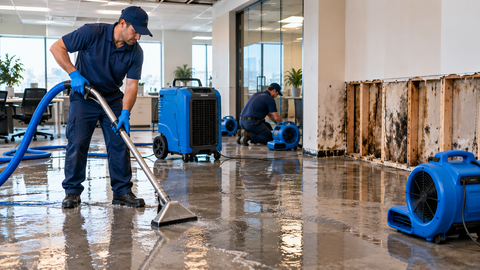
Industrial pumps and extraction equipment remove standing water from affected areas.
Step 4: Drying and Air Movement
High-capacity air movers accelerate evaporation and support structural drying.
Step 5: Dehumidification
Industrial dehumidifiers remove moisture from the air and help maintain controlled drying conditions.
Step 6: Cleaning and Sanitization
Affected surfaces are cleaned and treated based on the type of water involved.
Step 7: Restoration and Repairs
Damaged materials such as drywall, flooring, insulation, and ceiling systems may be repaired or replaced.
Equipment Used in Commercial Water Damage Restoration
Modern restoration projects often utilize:
- Moisture meters
- Thermal imaging cameras
- Water extraction pumps
- Portable extractors
- Industrial air movers
- Commercial dehumidifiers
- Air filtration units
- Drying chambers
- Monitoring systems
- Environmental measurement tools
Benefits and Advantages
Commercial water damage restoration provides several benefits:
- Reduced structural deterioration
- Improved property safety
- Better moisture control
- Enhanced indoor conditions
- Faster operational recovery
- Improved asset protection
- More accurate damage assessment
- Better documentation and tracking
- Increased building resilience
- Reduced long-term repair requirements
Industry Applications
Office Buildings
Protects workspaces, equipment, and operational continuity.
Healthcare Facilities
Supports safe environmental conditions and infrastructure protection.
Educational Institutions
Helps restore classrooms, administrative buildings, and shared facilities.
Warehouses
Protects inventory storage areas and operational infrastructure.
Hotels and Hospitality Facilities
Supports guest safety and building recovery.
Manufacturing Facilities
Protects production areas and utility systems.
Retail Buildings
Restores customer-facing areas and operational spaces.
Data Centers
Helps protect critical infrastructure and operational systems.
Real-World Examples
Example: Office Building Pipe Failure
A burst pipe damages several office floors. Restoration teams perform water extraction, drying, and repairs to affected walls and flooring.
Example: Warehouse Roof Leak
Heavy rainfall causes roof infiltration in a warehouse. Moisture detection tools identify affected storage areas, enabling targeted drying efforts.
Example: Healthcare Facility Water Intrusion
An equipment malfunction releases water into a medical facility. Restoration teams utilize advanced monitoring technologies to support rapid recovery.
Example: Hotel Water Damage Incident
A plumbing failure affects multiple guest rooms. Drying equipment and moisture monitoring technologies help restore affected areas.
Important Factors to Consider
When evaluating a restoration project, consider:
- Water category
- Property size
- Building materials
- Equipment exposure
- Structural conditions
- Drying requirements
- Indoor air quality
- Safety considerations
- Documentation needs
- Long-term maintenance requirements
Common Challenges and Solutions
| Challenge | Impact | Solution |
|---|---|---|
| Hidden Moisture | Long-Term Damage | Moisture Mapping |
| Large Affected Areas | Extended Drying Time | Industrial Equipment |
| High Humidity | Slower Drying | Dehumidification |
| Contaminated Water | Health Risks | Specialized Cleaning |
| Operational Disruption | Reduced Productivity | Structured Recovery Planning |
Commercial Water Damage Restoration Best Practices
- Respond quickly to water incidents.
- Stop the water source when possible.
- Document affected areas thoroughly.
- Utilize moisture detection technologies.
- Monitor drying progress regularly.
- Maintain proper ventilation.
- Inspect hidden spaces carefully.
- Follow structured restoration procedures.
- Conduct post-restoration inspections.
- Maintain preventive facility maintenance programs.
Prevention Tips
Many water-related incidents can be minimized through proactive planning.
- Inspect plumbing systems regularly.
- Monitor roofing conditions.
- Maintain drainage systems.
- Check HVAC equipment routinely.
- Utilize leak detection technologies.
- Review emergency response plans.
- Monitor utility infrastructure.
- Conduct periodic building inspections.
Future Trends and Industry Insights
Smart Moisture Monitoring
Connected sensors provide real-time moisture tracking across commercial properties.
Artificial Intelligence Analytics
AI-powered platforms help identify patterns and support restoration planning.
Predictive Maintenance
Advanced analytics can identify potential water-related issues before major incidents occur.
Digital Documentation
Modern restoration projects increasingly rely on digital reporting and monitoring technologies.
Building Automation Integration
Smart building systems can assist with leak detection and environmental monitoring.
Advanced Drying Technologies
New equipment designs continue improving drying efficiency and operational visibility.
Expert Insights
Commercial water damage restoration is becoming increasingly technology-driven. Modern projects utilize moisture mapping, environmental monitoring, digital documentation, and intelligent analytics to improve accuracy and efficiency.
As commercial buildings become more connected through smart infrastructure, restoration professionals can access better data, improve response strategies, and enhance overall recovery outcomes.
Key Takeaways
- Commercial water damage restoration is a structured recovery process.
- Early action improves restoration outcomes.
- Moisture detection is critical for identifying hidden damage.
- Water extraction and drying are essential restoration phases.
- Different water categories require different restoration approaches.
- Modern technologies improve monitoring and assessment.
- Preventive maintenance helps reduce future incidents.
- Smart building technologies are shaping future restoration practices.
Frequently Asked Questions (FAQ)
What is commercial water damage restoration?
It is the process of restoring commercial properties after water intrusion through assessment, extraction, drying, cleaning, and repair activities.
What causes commercial water damage?
Common causes include plumbing failures, roof leaks, storms, HVAC issues, and drainage problems.
How does water damage restoration work?
The process includes assessment, moisture detection, extraction, drying, dehumidification, cleaning, and restoration.
Why is moisture detection important?
Hidden moisture can remain inside walls, ceilings, and flooring even after visible water disappears.
What equipment is used during restoration?
Common equipment includes pumps, extractors, moisture meters, thermal cameras, air movers, and dehumidifiers.
What is the difference between clean water and black water?
Clean water has minimal contamination, while black water contains significant contaminants and requires specialized remediation.
What is moisture mapping?
Moisture mapping uses detection tools to identify affected areas and guide restoration activities.
Why is dehumidification necessary?
Dehumidification removes moisture from the air and supports the drying process.
What industries commonly require restoration?
Offices, healthcare facilities, schools, warehouses, hotels, retail buildings, and manufacturing facilities.
What is structural drying?
Structural drying removes moisture trapped within building materials and structural components.
How can businesses reduce water damage risks?
Regular inspections, preventive maintenance, leak detection systems, and emergency planning help reduce risks.
What role does thermal imaging play?
Thermal imaging helps identify hidden moisture behind walls and other surfaces.
What are air movers?
Air movers increase airflow and accelerate evaporation during drying.
What are industrial dehumidifiers?
These devices remove excess moisture from the air during restoration projects.
What future technologies are influencing restoration?
Smart sensors, AI analytics, predictive maintenance, digital documentation, and building automation technologies are becoming increasingly important.
Conclusion
Commercial water damage restoration is a comprehensive process that helps restore buildings, protect infrastructure, and support operational recovery after water-related incidents. Through assessment, moisture detection, extraction, drying, cleaning, and repair activities, restoration teams help return commercial properties to safe and functional conditions.
As technology continues to advance, smart monitoring systems, predictive analytics, digital documentation, and intelligent building infrastructure are improving restoration practices. Understanding the restoration process, common challenges, and preventive strategies can help organizations better prepare for future water-related events.

Related Post...