Rubber Mixing Mills Explained: Rubber Processing Systems
Rubber mixing mills are essential machines used in rubber manufacturing and polymer processing industries.
These machines blend raw rubber with additives, fillers, curing agents, pigments, and processing chemicals to create uniform rubber compounds for further production stages.
Widely used in tire manufacturing, industrial rubber products, automotive components, conveyor belts, seals, gaskets, and engineered elastomer products, rubber mixing mills help achieve consistent material properties before shaping and vulcanization processes. Understanding how these systems operate provides valuable insight into modern rubber processing technology.
Rubber Mixing Mills at a Glance
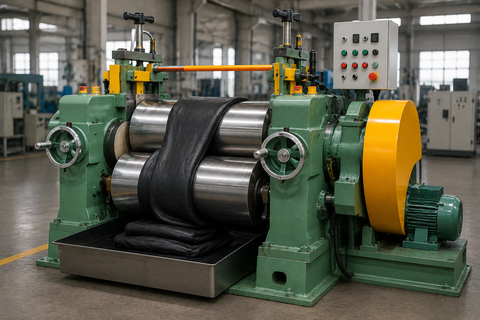
A rubber mixing mill is a two-roll processing machine designed to blend, refine, and homogenize rubber compounds. The machine uses rotating rolls operating at different speeds to generate shear forces that mix materials effectively. Rubber processing facilities commonly use these mills to prepare compounds before extrusion, calendaring, molding, or vulcanization operations.
Key Industry Facts
- Rubber mixing mills are widely used in tire and industrial rubber manufacturing.
- Two-roll mills remain common equipment in rubber compound preparation.
- Differential roll speeds improve mixing efficiency.
- Mills can process natural rubber and synthetic rubber compounds.
- Modern systems often incorporate automation and process monitoring.
- Consistent mixing influences final product quality and performance.
- Temperature control plays an important role during rubber processing.
How Rubber Mixing Mills Work
The mixing process relies on controlled mechanical action between two rotating rolls.
Basic Operating Process
- Raw rubber is fed into the mill.
- The rotating rolls draw material into the nip area.
- Shear forces break down and soften the rubber.
- Fillers, pigments, and additives are introduced.
- Continuous rolling and folding distribute ingredients evenly.
- Operators adjust processing parameters as needed.
- The finished compound is removed for downstream processing.
The process creates a more uniform rubber compound suitable for manufacturing applications.
Main Types of Rubber Mixing Mills
Laboratory Rubber Mills
Laboratory mills are used for research, product development, and quality testing.
Typical applications include:
- Compound development
- Material testing
- Process evaluation
- Small-batch production
Production Rubber Mixing Mills
Production mills are designed for continuous industrial processing and larger batch volumes.
Common uses include:
- Tire manufacturing
- Industrial rubber production
- Automotive rubber components
- Technical rubber products
Water-Cooled Mixing Mills
These mills incorporate cooling systems that help regulate roll temperature during operation.
Automated Rubber Mills
Advanced mills may include programmable controls, automated gap adjustment, process monitoring, and data collection features.
Comparison of Rubber Mixing Mill Types
| Mill Type | Typical Use | Production Scale |
|---|---|---|
| Laboratory Mill | Testing & Development | Small |
| Production Mill | Manufacturing | Large |
| Water-Cooled Mill | Temperature Control | Medium to Large |
| Automated Mill | Smart Processing | Large |
Core Components of Rubber Mixing Mills
Mixing Rolls
The rolls perform the primary mixing action and generate the shear forces necessary for compound development.
Drive System
Industrial motors and transmission systems rotate the rolls at controlled speeds.
Roll Gap Adjustment System
Operators can adjust the distance between rolls to influence mixing intensity.
Cooling and Heating Systems
Temperature management helps maintain process stability and material quality.
Safety Equipment
Modern mills incorporate emergency stops, safety bars, interlocks, and protective systems.
Control Panel
Control systems allow operators to monitor and adjust operating conditions.
Applications of Rubber Mixing Mills
Tire Manufacturing
Rubber compounds used in tire production require precise mixing to achieve desired performance characteristics.
Automotive Components
Manufacturers process rubber compounds for seals, hoses, bushings, mounts, and vibration-control products.
Conveyor Belt Production
Industrial conveyor systems often require specialized rubber compounds prepared through controlled mixing processes.
Industrial Rubber Products
Mixing mills support the production of:
- Gaskets
- Seals
- Rollers
- Rubber sheets
- Protective components
Footwear Manufacturing
Certain footwear products use rubber compounds prepared through milling operations.
Selection Factors
Choosing a rubber mixing mill involves evaluating several operational requirements.
Roll Size
Roll dimensions influence processing capacity and batch size.
Production Requirements
Expected output volume affects machine selection.
Temperature Control
Cooling and heating capabilities can influence compound consistency.
Automation Features
Modern facilities may require integration with digital monitoring systems.
Material Compatibility
The machine should support the intended rubber formulations.
Safety Features
Comprehensive safety systems are important for operator protection.
Benefits of Rubber Mixing Mills
- Supports uniform compound preparation
- Improves ingredient distribution
- Handles various rubber formulations
- Supports industrial-scale production
- Provides controlled material processing
- Enables compound refinement
- Supports quality consistency
- Integrates with downstream manufacturing processes
- Accommodates different additive systems
- Supports product development activities
Challenges and Limitations
Heat Generation
Mechanical processing can generate heat that requires temperature management.
Operator Skill Requirements
Effective compound preparation often requires process knowledge and experience.
Maintenance Needs
Rolls, bearings, drive systems, and safety components require routine inspection.
Production Variability
Inconsistent operating conditions can affect compound quality.
Space Requirements
Industrial mills may require significant production floor space.
Industry Standards and Compliance
Rubber processing facilities typically follow quality management, safety, environmental, and equipment maintenance procedures.
Important focus areas include:
- Equipment safety
- Process consistency
- Material traceability
- Product quality monitoring
- Operational documentation
- Maintenance management
Specific requirements vary by industry, product type, and operating region.
Safety Considerations
Rubber mixing mills involve rotating machinery and require appropriate safety practices.
Important measures include:
- Emergency stop systems
- Safety trip bars
- Operator training
- Lockout/tagout procedures
- Protective guarding
- Routine inspections
- Proper material handling
- Safe operating procedures
Safety planning should always align with facility requirements and equipment design.
Latest Technology Trends
Smart Manufacturing Integration
Modern mills increasingly connect with plant-wide monitoring systems.
Digital Process Monitoring
Sensors provide real-time information about temperature, speed, and operating conditions.
Predictive Maintenance
Condition-monitoring systems help identify developing equipment issues.
Automated Gap Control
Advanced systems improve consistency through automated roll adjustments.
Energy Efficiency Improvements
Manufacturers continue developing systems designed to optimize energy utilization.
Expert Insights
Rubber mixing mills remain one of the most important technologies in elastomer manufacturing because compound quality directly influences downstream production and final product performance. Modern facilities increasingly combine traditional mixing principles with automation, monitoring, and data-driven process control to improve consistency and operational visibility.
Key Takeaways
- Rubber mixing mills prepare uniform rubber compounds.
- Two-roll mills remain widely used in rubber processing.
- Temperature control influences compound quality.
- Industrial mills support large-scale manufacturing.
- Safety systems are critical for machine operation.
- Automation is expanding in modern rubber processing facilities.
- Consistent mixing supports product performance and quality.
- Preventive maintenance contributes to operational reliability.
Frequently Asked Questions
What is a rubber mixing mill?
A rubber mixing mill is a two-roll machine used to blend rubber and additives into a uniform compound for manufacturing applications.
How does a rubber mixing mill work?
The machine uses rotating rolls to generate shear forces that mix, refine, and homogenize rubber materials.
What industries use rubber mixing mills?
They are commonly used in tire manufacturing, automotive production, industrial rubber processing, footwear manufacturing, and elastomer product development.
Why is temperature control important?
Temperature influences material behavior, processing consistency, and compound quality during mixing operations.
What are the main components of a rubber mixing mill?
Key components include mixing rolls, drive systems, gap adjustment mechanisms, cooling systems, safety equipment, and control systems.
What is the purpose of differential roll speed?
Different roll speeds generate shear forces that improve mixing efficiency and material distribution.
Can rubber mixing mills be automated?
Yes. Modern systems may include automated controls, monitoring systems, and digital process management features.
Why is preventive maintenance important?
Routine maintenance helps maintain roll condition, drive performance, safety systems, and overall equipment reliability.
What materials can be processed?
Natural rubber, synthetic rubber, elastomers, fillers, pigments, and various processing additives can be incorporated into rubber compounds.
How do rubber mixing mills support product quality?
They help distribute ingredients uniformly, improving consistency throughout the manufacturing process.
Conclusion
Rubber mixing mills are fundamental machines in rubber processing and elastomer manufacturing. By combining raw rubber with fillers, additives, pigments, and curing agents, these systems help create uniform compounds for a wide range of industrial applications. From tire manufacturing and automotive components to conveyor belts and technical rubber products, mixing mills remain a key part of modern production operations.
As automation, digital monitoring, predictive maintenance, and smart manufacturing technologies continue to evolve, rubber mixing mills are becoming increasingly efficient and integrated within advanced production environments.

Related Post...