Temperature Monitoring: Enterprise Systems Guide
Temperature monitoring is the continuous or scheduled measurement, recording, and analysis of temperature conditions across equipment, facilities, products, and industrial processes.
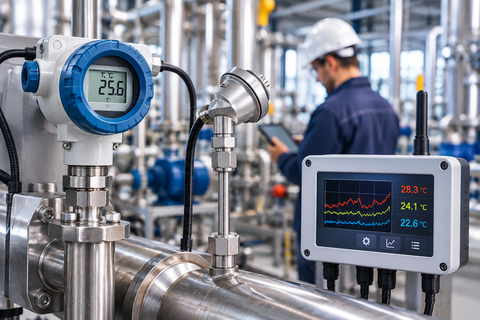
Enterprise temperature monitoring systems combine sensors, data loggers, communication networks, centralized dashboards, and alarm functions to help organizations maintain operating conditions, identify abnormal changes, and manage temperature-related information across multiple locations.
These systems are used in manufacturing, pharmaceuticals, food processing, healthcare, logistics, energy production, data centers, and commercial facilities. Enterprise-level monitoring extends beyond individual thermometers by connecting measurement devices and operational data into a coordinated monitoring architecture.
Quick Facts About Temperature Monitoring Systems
The following table summarizes the main characteristics of enterprise temperature monitoring.
Feature | Details |
|---|---|
Technology | Temperature measurement and monitoring |
Primary Purpose | Observe and record temperature conditions |
Main Components | Sensors, transmitters, data loggers, gateways, and dashboards |
Measurement Methods | Contact and non-contact |
Common Sensors | RTD, thermocouple, thermistor, and infrared |
Monitoring Approaches | Manual, continuous, wireless, and network-based |
Communication Methods | Ethernet, Wi-Fi, Bluetooth, Modbus, and industrial communication networks |
Data Management | Real-time readings, historical records, and temperature reports |
Alert Functions | High-temperature, low-temperature, and abnormal-condition notifications |
Common Industries | Manufacturing, pharmaceuticals, food processing, logistics, and energy |
Key Requirements | Accuracy, calibration, reliability, connectivity, and data integrity |
What Is Enterprise Temperature Monitoring?
Enterprise temperature monitoring is an organized approach to measuring and managing temperature information across multiple equipment units, production areas, buildings, or geographically distributed facilities.
Unlike a standalone temperature measurement device, an enterprise system connects multiple monitoring points to a shared data environment. This allows authorized personnel to review readings, compare operating conditions, receive alerts, and examine historical temperature records.
For example, a pharmaceutical manufacturing organization may need to monitor temperature conditions in production rooms, laboratory equipment, storage refrigerators, and distribution environments. An enterprise monitoring architecture can collect information from these locations and present it through centralized dashboards.
The system generally combines four major functions:
Measurement: Temperature sensors detect thermal conditions at designated locations.
Data collection: Transmitters and data loggers capture and transfer measurements.
Monitoring: Centralized platforms display current readings and historical information.
Management: Alarm configurations, reports, user permissions, and maintenance records support operational oversight.
Enterprise temperature monitoring can be implemented through wired infrastructure, wireless sensor networks, cloud-connected platforms, or hybrid architectures.
The main objective is to establish consistent visibility into temperature conditions while maintaining reliable measurement records across the organization.
Why Temperature Monitoring Matters for Enterprise Operations
Temperature variations can affect production quality, equipment performance, material stability, storage conditions, and operational reliability. Organizations that depend on controlled thermal environments need dependable measurement systems to identify changes before they create larger operational problems.
Enterprise monitoring provides a structured way to observe these conditions across multiple locations.
Product Quality Management
Temperature-sensitive materials may deteriorate or change characteristics when exposed to unsuitable conditions. Monitoring helps organizations identify deviations in production, processing, and storage environments.
Equipment Performance
Industrial equipment generates heat during operation. Monitoring motor temperatures, electrical components, bearings, and other critical parts can help identify abnormal thermal behavior.
Environmental Control
Manufacturing rooms, laboratories, warehouses, and controlled storage facilities often require defined temperature conditions. Monitoring helps facility personnel evaluate whether these environments remain within their configured operating limits.
Operational Visibility
Centralized temperature information allows personnel to review conditions across different departments and facilities without depending entirely on individual manual readings.
Maintenance Planning
Historical temperature records can help identify recurring overheating patterns, unusual fluctuations, and gradual changes that may indicate equipment deterioration.
Regulatory and Quality Documentation
Certain industries require documented evidence of environmental conditions and measurement practices. Properly configured monitoring systems support recordkeeping, review, and quality management activities.
How an Enterprise Temperature Monitoring System Works
An enterprise temperature monitoring system follows a sequence that begins with physical measurement and ends with centralized information management.
The architecture may vary depending on the number of monitoring points, communication requirements, and operational environment.
1. Temperature Measurement
Sensors are installed at selected measurement points. They detect temperature through electrical resistance changes, thermoelectric voltage, semiconductor behavior, or infrared radiation.
The sensor type depends on the measurement range, required accuracy, installation conditions, and target material.
2. Signal Conditioning and Conversion
The sensor produces an electrical or electronic signal corresponding to the measured temperature.
A transmitter or measurement module processes this signal, applies the appropriate conversion, and produces a readable temperature value.
Signal conditioning may include amplification, filtering, linearization, and compensation.
3. Data Collection
Data acquisition equipment collects temperature readings from connected sensors. Depending on the installation, this function may be performed by a dedicated data logger, PLC, remote input module, or monitoring gateway.
The collected information may include:
Temperature readings.
Measurement timestamps.
Sensor identification.
Device operating status.
Communication conditions.
Configured alarm states.
4. Data Transmission
Collected readings are transferred through an established communication network.
Wired systems may use Ethernet, industrial serial communication, or dedicated instrumentation connections. Wireless installations may use Wi-Fi, Bluetooth, or other supported wireless communication technologies.
5. Centralized Monitoring
The monitoring platform receives incoming information and displays temperature conditions through dashboards, charts, device lists, and location-based views.
Authorized personnel can examine individual sensors or compare measurements across different facilities.
6. Alarm Generation
The system evaluates incoming readings against configured temperature limits.
When a measurement crosses an established threshold, the platform can generate notifications through supported channels such as email, SMS, local alarms, or dashboard alerts.
7. Historical Data Management
Temperature readings are stored for later examination. Personnel can review previous measurements, identify trends, investigate temperature excursions, and prepare operational reports.
The following table summarizes the typical workflow.
Stage | System Element | Main Function |
|---|---|---|
1 | Temperature Sensor | Measures thermal conditions |
2 | Transmitter | Converts sensor signals into usable values |
3 | Data Logger or Acquisition Module | Collects and timestamps readings |
4 | Communication Gateway | Transfers information |
5 | Monitoring Platform | Displays and organizes temperature data |
6 | Alarm Engine | Identifies configured temperature deviations |
7 | Data Storage | Maintains historical records and reports |
Main Types of Temperature Monitoring Systems
Temperature monitoring systems can be classified according to their measurement method, communication architecture, and data management approach. These classifications describe different aspects of a monitoring installation and should not be confused with individual sensor technologies.
1. Manual Temperature Monitoring
Manual temperature monitoring involves personnel measuring and recording temperatures at scheduled intervals.
It commonly uses digital thermometers, handheld temperature instruments, and portable measurement devices.
Main characteristics:
Measurements are performed by personnel.
Records may be maintained in paper logs or digital documents.
Suitable for applications with limited monitoring points.
Requires consistent measurement procedures.
Typical applications: Small storage facilities, routine equipment inspections, and basic environmental checks.
2. Continuous Temperature Monitoring
Continuous temperature monitoring uses connected sensors and electronic measurement equipment to capture readings automatically.
The system can collect measurements at configured intervals and provide ongoing visibility into operating conditions.
Main characteristics:
Automated measurement and data collection.
Supports temperature trend analysis.
Can generate alerts when configured limits are crossed.
Reduces dependence on manual readings.
Typical applications: Industrial processing, pharmaceutical storage, refrigeration systems, and controlled production environments.
3. Wireless Temperature Monitoring
Wireless temperature monitoring uses battery-powered or externally powered sensors that transmit measurements without requiring a dedicated signal cable between every sensor and the receiving system.
Depending on the technology, communication may use Wi-Fi, Bluetooth, or other wireless networking methods.
Main characteristics:
Reduces signal cabling requirements.
Supports flexible sensor placement.
Can accommodate distributed monitoring points.
Requires consideration of battery condition and wireless coverage.
Typical applications: Warehouses, cold storage facilities, building monitoring, and distributed equipment installations.
4. Wired Temperature Monitoring
Wired temperature monitoring connects sensors and measurement devices through physical communication or instrumentation cables.
It is commonly used in industrial environments where fixed sensor locations, predictable connectivity, and integration with existing control infrastructure are important.
Main characteristics:
Physical connections between system components.
Suitable for permanent monitoring installations.
Can integrate with PLC and industrial control networks.
Requires cable routing and installation planning.
Typical applications: Manufacturing plants, processing equipment, industrial furnaces, and centralized control rooms.
5. Cloud-Based Temperature Monitoring
Cloud-based temperature monitoring uses network-connected devices to transfer temperature information to a hosted data platform.
Authorized users can access readings, dashboards, historical information, and alerts through supported devices.
Main characteristics:
Centralized data access.
Supports geographically distributed monitoring.
Can provide remote notifications.
Depends on network connectivity and appropriate cybersecurity controls.
Typical applications: Multi-location enterprises, logistics networks, pharmaceutical distribution, and large storage operations.
6. On-Premises Temperature Monitoring
On-premises monitoring stores and processes temperature information within an organization's own computing infrastructure.
The system may operate through local servers, industrial computers, internal databases, and facility networks.
Main characteristics:
Data processing within organizational infrastructure.
Greater direct control over local system administration.
Can support integration with existing industrial networks.
Requires internal infrastructure maintenance and backup planning.
Typical applications: Industrial plants, controlled production facilities, research laboratories, and organizations with specific data management requirements.
Temperature Monitoring System Type Comparison
The following table compares the main monitoring architectures and their operational characteristics.
System Type | Measurement or Communication Approach | Main Advantage | Main Consideration |
|---|---|---|---|
Manual | Scheduled human readings | Simple implementation | Limited measurement frequency |
Continuous | Automated sensor readings | Ongoing visibility | Requires electronic infrastructure |
Wireless | Radio-based communication | Flexible installation | Coverage and battery management |
Wired | Physical connections | Predictable connectivity | Cable installation requirements |
Cloud-Based | Hosted data platform | Centralized remote access | Network and cloud security |
On-Premises | Local computing infrastructure | Local data management | Internal infrastructure responsibilities |
These approaches can be combined. For example, an enterprise may use wireless sensors connected to local gateways that transfer information to a centralized cloud platform.
Main Temperature Monitoring Sensor Technologies
Temperature sensors are the measurement foundation of an enterprise monitoring system. Different technologies use different physical principles, and their suitability depends on the temperature range, measurement environment, and required performance.
1. Resistance Temperature Detectors (RTDs)
RTDs measure temperature through changes in electrical resistance. Platinum is commonly used because of its stable and predictable resistance-temperature relationship.
The Pt100 and Pt1000 are widely recognized platinum RTD configurations.
Characteristics:
Good measurement accuracy and stability.
Suitable for industrial process monitoring.
Available in different probe constructions.
Requires an appropriate resistance measurement circuit.
Applications: Pharmaceutical processing, laboratory equipment, industrial tanks, and precision manufacturing.
2. Thermocouples
Thermocouples consist of two dissimilar metallic conductors joined at a measurement junction. A temperature difference produces a small electrical voltage that can be converted into a temperature reading.
Different thermocouple types use different metal combinations and have different operating characteristics.
Characteristics:
Suitable for a broad range of temperatures.
Available in rugged industrial constructions.
Can respond quickly to changing conditions.
Requires appropriate reference-junction compensation and signal conditioning.
Applications: Furnaces, kilns, boilers, industrial ovens, and high-temperature manufacturing processes.
3. Thermistors
Thermistors are temperature-sensitive resistors whose electrical resistance changes significantly with temperature.
They are commonly classified as negative temperature coefficient (NTC) and positive temperature coefficient (PTC) devices.
Characteristics:
High sensitivity within their intended operating range.
Compact sensor construction.
Suitable for electronic temperature measurement.
Generally have a more limited operating range than many industrial thermocouples.
Applications: HVAC equipment, refrigeration systems, electronic devices, and temperature-sensitive storage units.
4. Infrared Temperature Sensors
Infrared sensors measure thermal radiation emitted by an object and estimate its surface temperature without physical contact.
They are useful when the target is moving, difficult to access, or unsuitable for direct sensor contact.
Characteristics:
Non-contact temperature measurement.
Suitable for moving or inaccessible targets.
Supports rapid surface temperature assessment.
Measurement accuracy depends on factors such as emissivity, distance, and environmental conditions.
Applications: Rotating machinery, electrical equipment, production lines, and industrial furnaces.
5. Semiconductor Temperature Sensors
Semiconductor temperature sensors use temperature-dependent electrical characteristics within electronic components to determine temperature.
They may provide analog voltage, current, or digital output depending on the device design.
Characteristics:
Compact electronic construction.
Convenient integration with digital monitoring equipment.
Suitable for electronic assemblies and low-temperature applications.
Operating limits depend on the sensor design.
Applications: Electronic equipment, circuit boards, data center hardware, and embedded monitoring devices.
Main Components of an Enterprise Temperature Monitoring System
An enterprise monitoring architecture includes several interconnected components that support measurement, communication, visualization, and data management.
Component | Primary Function | Technical Role |
|---|---|---|
Temperature Sensors | Detect temperature | Convert thermal conditions into measurable signals |
Temperature Transmitters | Process sensor signals | Convert measurements into standardized outputs |
Data Loggers | Record readings | Maintain timestamped temperature information |
Data Acquisition Modules | Collect sensor signals | Transfer measurements into monitoring infrastructure |
Communication Gateways | Connect different networks | Transfer information between devices and platforms |
Network Infrastructure | Enable communication | Supports wired and wireless data exchange |
Monitoring Platform | Display temperature information | Provides dashboards and device management |
Alarm Management System | Identify temperature deviations | Generates configured notifications |
Database | Store historical information | Supports reporting and analysis |
User Interface | Provide system access | Allows authorized personnel to review monitoring information |
Not every enterprise installation requires all components as separate devices. Some systems integrate data collection, communication, and processing functions into a single monitoring unit.
Applications of Enterprise Temperature Monitoring Across Industries
Temperature monitoring is used in industries where thermal conditions affect products, equipment, environmental stability, or production quality.
1. Pharmaceutical Manufacturing and Storage
Pharmaceutical operations require controlled temperature conditions for various materials, manufacturing processes, and storage environments.
Monitoring systems can measure conditions in:
Pharmaceutical refrigerators.
Controlled storage rooms.
Manufacturing areas.
Laboratory equipment.
Temperature-controlled warehouses.
Historical records and alarm notifications help personnel identify temperature excursions and investigate their potential effects on stored materials.
2. Food Processing and Cold Storage
Food processing facilities monitor temperature throughout manufacturing, refrigeration, storage, and distribution activities.
Temperature monitoring can be applied to:
Industrial refrigeration systems.
Cold storage warehouses.
Processing equipment.
Food preparation environments.
Refrigerated transportation units.
Monitoring helps identify abnormal temperature changes that may affect product quality or storage conditions.
3. Industrial Manufacturing
Manufacturing facilities use temperature sensors to observe thermal conditions in production equipment and industrial processes.
Common applications include:
Injection molding machines.
Industrial ovens.
CNC equipment.
Metal processing systems.
Plastic manufacturing machinery.
Industrial compressors.
Temperature information can also support maintenance investigations when equipment operates outside its expected thermal behavior.
4. Data Centers and IT Infrastructure
Data centers require temperature monitoring to evaluate cooling performance and environmental conditions around computing equipment.
Monitoring points may include server racks, air supply areas, return air locations, cooling equipment, and electrical infrastructure.
Distributed sensors help facility personnel identify temperature variations across different areas of a computing environment.
5. Healthcare and Medical Facilities
Healthcare facilities use temperature monitoring for medical refrigerators, laboratory environments, storage areas, and selected medical equipment.
Temperature records can help personnel review environmental conditions and investigate deviations that may affect sensitive materials.
6. Warehousing and Logistics
Warehouses and logistics facilities may monitor temperature across multiple storage zones and transportation environments.
Enterprise systems can combine readings from fixed sensors, portable data loggers, and connected monitoring devices.
This supports visibility across storage and distribution operations, particularly when temperature-sensitive materials are involved.
7. Energy and Power Generation
Power generation and energy facilities monitor temperatures in generators, transformers, motors, turbines, electrical enclosures, and other critical equipment.
Abnormal temperature patterns may indicate excessive loading, cooling problems, electrical faults, or mechanical deterioration.
Monitoring information can support equipment condition assessment and maintenance planning.
8. Commercial Buildings and HVAC Systems
Commercial facilities use temperature monitoring to observe indoor environmental conditions and HVAC equipment performance.
Centralized systems can collect readings from different floors, rooms, air handling units, and building zones.
This information helps facility personnel evaluate temperature distribution and investigate environmental control problems.
Benefits and Advantages of Enterprise Temperature Monitoring
Enterprise temperature monitoring provides operational benefits by combining distributed measurement points with centralized information management.
Centralized visibility: Personnel can review temperature conditions across multiple departments, equipment units, and facilities through a common monitoring environment.
Automated data collection: Connected sensors reduce dependence on repeated manual measurements and support consistent recordkeeping.
Faster deviation identification: Configured alarm functions notify authorized personnel when temperature readings move outside established limits.
Improved historical analysis: Stored measurements help organizations examine temperature patterns, identify recurring problems, and investigate previous excursions.
Better equipment oversight: Temperature information can help identify abnormal thermal conditions in machinery, electrical systems, and industrial infrastructure.
Consistent monitoring procedures: Standardized configurations can help maintain similar measurement and reporting practices across different locations.
Operational coordination: Centralized information allows maintenance, quality, and facility teams to review relevant temperature conditions using shared records.
Common Temperature Monitoring Challenges and Solutions
Enterprise installations can encounter measurement, communication, infrastructure, and data management problems. Identifying these challenges helps maintain monitoring reliability.
Common Challenge | Potential Impact | Recommended Approach |
|---|---|---|
Sensor drift | Increasing measurement error | Establish calibration and verification schedules |
Incorrect sensor placement | Unrepresentative readings | Conduct temperature mapping and installation assessments |
Wireless interference | Missing or delayed readings | Evaluate network coverage and interference |
Power interruptions | Monitoring downtime | Use appropriate backup power arrangements |
Communication failures | Incomplete temperature records | Monitor network connectivity and device status |
Incorrect alarm thresholds | Unnecessary or missed notifications | Review limits against process requirements |
Poor data organization | Difficult historical analysis | Establish consistent device naming and location records |
Environmental exposure | Sensor degradation | Select suitable sensor protection and installation methods |
Unauthorized access | Data or configuration changes | Apply authentication and role-based access |
Inadequate maintenance | Reduced measurement reliability | Maintain documented inspection and calibration procedures |
Sensor placement is particularly important. A sensor installed near a heat source, ventilation outlet, doorway, or other unrepresentative location may produce readings that do not reflect the actual condition of the monitored area.
How to Choose an Enterprise Temperature Monitoring System
Selecting an enterprise temperature monitoring system requires an evaluation of measurement requirements, installation conditions, communication architecture, data management, and future expansion needs.
The following selection criteria provide a practical framework.
Selection Factor | What to Evaluate | Why It Matters |
|---|---|---|
Measurement Range | Minimum and maximum operating temperatures | Ensures sensor suitability |
Accuracy Requirements | Required measurement uncertainty | Supports process and quality requirements |
Sensor Technology | RTD, thermocouple, thermistor, or infrared | Determines measurement performance |
Monitoring Frequency | Scheduled or continuous readings | Defines data collection requirements |
Number of Locations | Sensors, rooms, machines, and facilities | Determines system capacity |
Communication Method | Wired, wireless, or hybrid | Influences installation architecture |
Data Storage | Local, centralized, or cloud-based | Determines historical record management |
Alarm Configuration | Thresholds, delays, and notification channels | Supports timely deviation identification |
Integration | PLC, SCADA, BMS, and enterprise platforms | Enables information exchange |
Cybersecurity | Authentication, access permissions, and network protection | Protects monitoring infrastructure |
Calibration | Verification procedures and traceability | Supports measurement reliability |
Expansion Capacity | Additional sensors and locations | Accommodates organizational growth |
For example, a manufacturing facility with permanent sensor installations may prioritize wired connectivity and industrial control integration. A distributed logistics organization may require wireless monitoring, portable data loggers, and centralized access.
The system architecture should match the actual operational requirements rather than introducing unnecessary complexity.
Enterprise Temperature Monitoring Standards and Measurement Quality
Temperature measurement quality depends on suitable sensor selection, calibration, installation practices, and consistent data management. Recognized standards provide technical frameworks for specific measurement technologies and laboratory activities.
IEC 60751: Industrial Platinum Resistance Thermometers and Platinum Temperature Sensors
IEC 60751 specifies requirements for industrial platinum resistance thermometers and platinum temperature sensors. It defines the relationship between electrical resistance and temperature, supporting standardized RTD measurement.
It is particularly relevant to installations using platinum sensors such as Pt100 and Pt1000 devices.
IEC 60584-1: Thermocouples – EMF Specifications and Tolerances
IEC 60584-1 establishes reference functions and tolerances for designated thermocouple types.
It supports the standardized conversion of thermocouple electrical output into temperature values and is relevant to industrial thermocouple measurement systems.
ISO/IEC 17025: General Requirements for the Competence of Testing and Calibration Laboratories
ISO/IEC 17025 specifies requirements for the competence, impartiality, and consistent operation of testing and calibration laboratories.
It is relevant when organizations use external or internal laboratories for temperature instrument calibration and require technically valid measurement results.
ISO 10012: Measurement Management Systems – Requirements for Measurement Processes and Measuring Equipment
ISO 10012 addresses measurement management systems, including requirements for measurement processes and measuring equipment.
It provides a framework for managing measurement activities and maintaining confidence in measurement results.
Standards should be selected according to the measurement technology, industry requirements, and intended application. Compliance with a sensor standard alone does not establish that an entire enterprise monitoring installation is suitable for every process.
Temperature Monitoring Maintenance Best Practices
Regular maintenance helps preserve sensor performance, data reliability, and system availability. Enterprise organizations should establish documented maintenance procedures covering measurement devices, communication infrastructure, and monitoring platforms.
Sensor Calibration and Verification
Temperature sensors should be calibrated or verified according to their application, measurement requirements, manufacturer recommendations, and organizational quality procedures.
Calibration records should identify the instrument, measurement points, results, and relevant traceability information.
Sensor Inspection
Inspect probes, protective sheaths, cables, connectors, mounting arrangements, and enclosures for physical damage or deterioration.
Pay attention to sensors operating in corrosive, humid, vibrating, or high-temperature environments.
Communication Network Inspection
Review wired and wireless communication connections. Investigate missing readings, intermittent connections, unusual transmission delays, and gateway interruptions.
Alarm Function Testing
Verify that configured temperature limits, alarm delays, notifications, and escalation procedures operate as intended.
Testing should follow approved procedures and avoid unnecessary disruption to active operations.
Data Storage and Backup Review
Check that temperature records are stored correctly and that backup and recovery procedures are functioning.
Historical records should remain organized and accessible according to the organization's documentation requirements.
Power and Battery Maintenance
Inspect power supplies, backup power arrangements, and battery-operated wireless sensors. Replace batteries according to device condition and maintenance procedures.
System Configuration Management
Maintain records of sensor locations, device identifiers, temperature thresholds, communication settings, and approved configuration changes.
This information helps technical teams troubleshoot issues and maintain consistent monitoring practices across facilities.
Limitations of Enterprise Temperature Monitoring Systems
Although enterprise monitoring improves temperature visibility, it has technical and operational limitations that organizations must consider.
Measurement uncertainty: Every sensor and measurement instrument has limitations that affect the accuracy of recorded values.
Sensor degradation: Environmental exposure, aging, and mechanical damage can affect sensor performance.
Network dependency: Connected systems may experience data interruptions when communication infrastructure fails.
Installation complexity: Large deployments require planning for sensor placement, connectivity, power, and data management.
Cybersecurity risks: Network-connected monitoring devices introduce potential access and infrastructure vulnerabilities.
Maintenance requirements: Calibration, verification, battery replacement, and hardware inspection require ongoing attention.
Data interpretation: Temperature readings alone may not explain the cause of an abnormal condition or establish whether a product or process has been affected.
Organizations should also distinguish between temperature monitoring and temperature control. Monitoring systems measure and report conditions, while control systems actively regulate temperature through equipment such as heaters, chillers, compressors, and HVAC units.
Some enterprise platforms combine monitoring and control functions, but these responsibilities should remain clearly defined within the system architecture.
Future Trends in Enterprise Temperature Monitoring
Enterprise temperature monitoring is developing through advances in connected sensors, industrial networking, data processing, and automated analysis.
Industrial Internet of Things Integration
Industrial Internet of Things (IIoT) technologies connect temperature sensors, gateways, equipment, and monitoring platforms. This architecture supports distributed measurement and centralized information management across industrial facilities.
Edge Computing
Edge computing allows selected data processing to take place closer to the measurement devices. This can support local alarm processing, data filtering, and monitoring functions without requiring every operation to depend on a remote platform.
Predictive Temperature Analysis
Temperature trends can be combined with other equipment measurements to help identify unusual operating patterns. When integrated with appropriate analytics, this information can support condition monitoring and maintenance planning.
Advanced Wireless Sensor Networks
Wireless sensor technologies continue to expand monitoring possibilities in warehouses, production environments, and distributed infrastructure.
Battery performance, communication coverage, interference, and environmental protection remain important design considerations.
Centralized Multi-Site Monitoring
Organizations increasingly require consistent visibility across geographically distributed operations. Centralized monitoring architectures can help standardize sensor management, reporting, alarm handling, and historical analysis.
Improved Data Integration
Enterprise temperature monitoring platforms can exchange information with manufacturing systems, building management systems, supervisory control platforms, and quality management environments.
This integration can provide broader operational context for temperature readings and support coordinated decision-making.
Frequently Asked Questions About Temperature Monitoring Systems
1. What is an enterprise temperature monitoring system?
An enterprise temperature monitoring system is a connected arrangement of sensors, data acquisition devices, communication infrastructure, and monitoring platforms. It collects temperature information from multiple locations and provides centralized access to readings, alarms, and historical records.
2. What are the main types of temperature monitoring systems?
The main monitoring approaches include manual, continuous, wireless, wired, cloud-based, and on-premises systems. These categories describe different measurement and infrastructure arrangements rather than individual temperature sensor technologies.
3. Which sensors are commonly used for industrial temperature monitoring?
Common industrial temperature sensors include resistance temperature detectors, thermocouples, thermistors, infrared sensors, and semiconductor devices. Selection depends on operating temperature, accuracy requirements, response characteristics, and installation conditions.
4. What is the difference between temperature monitoring and temperature control?
Temperature monitoring measures, records, and displays thermal conditions. Temperature control actively adjusts heating or cooling equipment to maintain a desired operating condition. Some industrial systems combine both functions.
5. How does wireless temperature monitoring work?
Wireless temperature monitoring uses connected sensors to transmit measurements through supported radio communication technologies. Gateways or receiving devices collect the readings and forward them to a monitoring platform for visualization, storage, and alarm management.
6. What industries require enterprise temperature monitoring?
Common applications include pharmaceutical manufacturing, food processing, healthcare, logistics, industrial manufacturing, data centers, energy production, and commercial building management. These industries use monitoring to evaluate product environments, equipment conditions, and facility temperatures.
7. Why is temperature sensor calibration important?
Calibration helps determine how closely an instrument's readings correspond to recognized temperature references. It provides information about measurement error and supports confidence in temperature records used for operational and quality decisions.
8. What is a temperature data logger?
A temperature data logger is an electronic device that records temperature readings over time. Depending on its design, it may include an integrated sensor, external sensor connections, internal memory, timestamps, and communication capabilities.
9. Can an enterprise temperature monitoring system monitor multiple locations?
Yes. Enterprise architectures can collect measurements from multiple rooms, machines, warehouses, buildings, and geographically distributed facilities. The number of supported monitoring points depends on system capacity, network architecture, and platform configuration.
10. What is the difference between cloud-based and on-premises temperature monitoring?
Cloud-based systems store or process monitoring information through hosted infrastructure, allowing authorized remote access. On-premises systems use an organization's local computing infrastructure for data processing and storage. Some enterprises use hybrid architectures that combine both approaches.
Conclusion
Enterprise temperature monitoring provides a structured approach to measuring, recording, and managing thermal conditions across industrial operations and distributed facilities. By combining appropriate sensors, data loggers, communication networks, centralized dashboards, and alarm functions, organizations can improve operational visibility and maintain consistent temperature records. Successful implementation depends on accurate sensor selection, suitable system architecture, calibration practices, reliable connectivity, and effective data management. As IIoT, edge computing, wireless networking, and industrial analytics continue to develop, enterprise monitoring systems will support increasingly connected and coordinated temperature management across multiple industries.

Related Post...



Tablet Setup for Seniors: Complete Guide to Easy Configuration and Accessibility
Updated: November 02, 2026
Read More