Vibration Monitoring: Modern Predictive Systems Guide
Vibration monitoring has become one of the most important technologies in modern predictive maintenance programs.
Industries rely on rotating equipment such as motors, pumps, compressors, turbines, conveyors, generators, and industrial fans to maintain continuous operations. Even minor mechanical issues can lead to unexpected downtime, reduced efficiency, and equipment damage.
Modern vibration monitoring systems help maintenance teams detect developing problems before they become serious failures. By continuously measuring and analyzing vibration patterns, organizations can identify abnormalities, schedule maintenance more effectively, and improve equipment reliability.
As industrial automation, Industrial Internet of Things (IIoT), and smart manufacturing technologies continue to advance, vibration monitoring is becoming a critical component of asset health management and predictive maintenance strategies.
Quick Facts About Vibration Monitoring
| Feature | Details |
|---|---|
| Primary Function | Equipment Condition Monitoring |
| Monitoring Method | Continuous or Periodic Measurement |
| Main Technology | Vibration Sensors |
| Common Assets | Motors, Pumps, Turbines, Compressors |
| Maintenance Strategy | Predictive Maintenance |
| Data Collection | Real-Time Monitoring |
| Key Benefit | Early Fault Detection |
| Industry Usage | Manufacturing, Energy, Mining, Oil & Gas |
What Is Vibration Monitoring?
Vibration monitoring is the process of measuring and analyzing mechanical vibrations produced by machines and equipment during operation. Every rotating machine generates some level of vibration. Changes in vibration behavior often indicate developing mechanical issues.
For example, a motor operating under normal conditions produces predictable vibration patterns. If a bearing begins to wear or a shaft becomes misaligned, the vibration signature changes. Monitoring systems detect these changes and provide valuable information about equipment condition.
By identifying issues early, maintenance teams can plan corrective actions before equipment performance deteriorates significantly.
Understanding the Concept of Predictive Maintenance
Predictive maintenance uses equipment condition data to anticipate potential failures before they occur.
Unlike reactive maintenance, which addresses problems after failure, predictive maintenance focuses on early detection and prevention.
Maintenance Strategy Comparison
| Strategy | Approach | Outcome |
|---|---|---|
| Reactive Maintenance | Repair after failure | Unexpected downtime |
| Preventive Maintenance | Scheduled intervals | Regular maintenance activities |
| Predictive Maintenance | Condition-based monitoring | Early fault detection |
| Reliability-Centered Maintenance | Risk-based planning | Optimized asset management |
Vibration monitoring serves as one of the most widely used predictive maintenance technologies because many mechanical failures generate detectable vibration changes.
Why Vibration Monitoring Matters
Mechanical equipment often shows warning signs long before complete failure occurs.
Common Detectable Problems
- Bearing wear
- Shaft misalignment
- Rotor imbalance
- Mechanical looseness
- Gear wear
- Coupling issues
- Structural resonance
- Cavitation in pumps
Detecting these conditions early helps improve equipment availability and operational efficiency.
Vibration Monitoring System Architecture
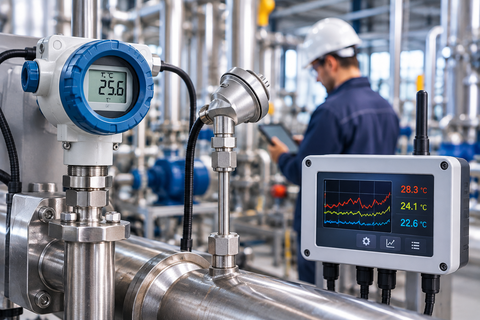
A modern vibration monitoring system consists of multiple interconnected components that work together to collect, analyze, and interpret machine health data.
Sensor Layer
Sensors measure vibration directly from equipment surfaces.
Data Acquisition Layer
Data acquisition devices collect and process sensor signals.
Communication Layer
Communication systems transfer information to monitoring platforms.
Analytics Layer
Software platforms analyze collected vibration data.
Visualization Layer
Dashboards present information through charts, alarms, and reports.
Maintenance Decision Layer
Maintenance teams use analyzed information to make operational decisions.
Main Components of a Vibration Monitoring System
| Component | Function |
|---|---|
| Accelerometer | Measures vibration acceleration |
| Velocity Sensor | Measures vibration velocity |
| Displacement Sensor | Measures shaft movement |
| Data Collector | Records vibration data |
| Gateway Device | Transfers information |
| Monitoring Platform | Analyzes data |
| Dashboard | Displays results |
| Alarm System | Generates alerts |
Types of Vibration Sensors
Accelerometers
Accelerometers are the most common vibration monitoring sensors. They measure acceleration and provide detailed information across a wide frequency range.
Velocity Sensors
Velocity sensors measure vibration speed and are widely used for rotating machinery condition assessment.
Displacement Sensors
These sensors measure shaft movement relative to machine components.
MEMS Sensors
Micro-Electro-Mechanical Systems (MEMS) sensors enable compact wireless monitoring solutions.
Sensor Comparison Table
| Sensor Type | Measurement | Typical Application |
|---|---|---|
| Accelerometer | Acceleration | Predictive maintenance |
| Velocity Sensor | Velocity | Rotating equipment |
| Displacement Sensor | Displacement | Turbines and shafts |
| MEMS Sensor | Multi-parameter monitoring | Wireless monitoring |
How Vibration Monitoring Works
Step 1: Sensor Installation
Sensors are mounted on critical equipment locations.
Step 2: Data Collection
Sensors continuously collect vibration measurements.
Step 3: Signal Processing
Raw vibration signals are converted into usable information.
Step 4: Frequency Analysis
Monitoring systems analyze vibration frequencies.
Step 5: Fault Identification
Patterns are compared against known fault signatures.
Step 6: Alert Generation
Abnormal conditions trigger maintenance notifications.
Vibration Monitoring Workflow
| Stage | Purpose |
|---|---|
| Data Collection | Measure equipment vibration |
| Signal Processing | Convert raw data |
| Frequency Analysis | Identify patterns |
| Fault Detection | Recognize abnormalities |
| Alarm Generation | Notify maintenance teams |
| Maintenance Planning | Schedule corrective actions |
Key Vibration Parameters
Vibration Acceleration
Useful for detecting high-frequency faults.
Vibration Velocity
Widely used for evaluating overall machine condition.
Vibration Displacement
Measures movement relative to a reference position.
Frequency Spectrum
Shows how vibration energy is distributed across frequencies.
Phase Analysis
Helps diagnose alignment and balancing issues.
Important Measurement Units
| Parameter | Unit |
|---|---|
| Acceleration | g or m/s² |
| Velocity | mm/s |
| Displacement | micrometers (µm) |
| Frequency | Hz |
| Temperature | °C |
Common Equipment Monitored
Electric Motors
Motors are among the most frequently monitored assets.
Pumps
Pump vibration analysis can reveal cavitation and bearing issues.
Compressors
Monitoring supports compressor reliability programs.
Industrial Fans
Fan imbalance and bearing wear are commonly detected.
Turbines
Critical turbines require continuous condition monitoring.
Gearboxes
Gear wear often creates identifiable vibration signatures.
Equipment Monitoring Matrix
| Equipment | Common Faults |
|---|---|
| Motor | Bearing wear, imbalance |
| Pump | Cavitation, misalignment |
| Compressor | Bearing damage |
| Fan | Imbalance |
| Gearbox | Gear wear |
| Turbine | Rotor instability |
Benefits and Advantages
Early Fault Detection
Potential failures can be identified before severe damage occurs.
Reduced Downtime
Planned maintenance reduces unexpected interruptions.
Improved Reliability
Assets remain available for longer operational periods.
Enhanced Safety
Monitoring helps identify equipment issues that could create operational risks.
Better Maintenance Planning
Maintenance resources can be allocated more effectively.
Vibration Monitoring Statistics and Industry Facts
| Fact | Insight |
|---|---|
| Predictive maintenance programs are expanding globally | Industries increasingly adopt condition monitoring |
| Bearings are among the most monitored components | Bearing faults generate measurable vibration signatures |
| Wireless sensors are growing rapidly | Support easier deployment |
| IIoT integration continues to increase | Enables real-time monitoring |
| Data analytics improves fault detection accuracy | Supports predictive strategies |
Real-World Applications
Manufacturing Facilities
Production equipment monitoring.
Power Generation
Turbines and generators require continuous observation.
Mining Operations
Heavy equipment condition assessment.
Oil and Gas Facilities
Rotating machinery health monitoring.
Water Treatment Plants
Pump and motor monitoring.
Transportation Infrastructure
Monitoring of critical rotating assets.
Noise and Operating Environment Considerations
Environmental conditions can influence vibration measurements.
Temperature Variations
Extreme temperatures may affect sensor performance.
Humidity Levels
Moisture protection is important in challenging environments.
Dust and Contamination
Protective housings help maintain measurement accuracy.
Electromagnetic Interference
Proper installation reduces interference risks.
Industry Standards and Safety
Several international standards support vibration monitoring programs.
ISO 10816
Provides guidance for evaluating machine vibration.
ISO 20816
Modern framework for machine vibration evaluation.
Machinery Health Standards
Support consistent monitoring practices.
Safety Integration
Monitoring systems often integrate with broader asset management programs.
Common Challenges and Practical Solutions
| Challenge | Solution |
|---|---|
| Sensor Placement Errors | Follow installation guidelines |
| Data Overload | Use automated analytics |
| Environmental Interference | Apply protective measures |
| False Alarms | Optimize thresholds |
| Limited Historical Data | Build baseline measurements |
| Equipment Complexity | Use expert analysis |
Best Practices for Effective Monitoring
Establish Baselines
Measure equipment under healthy operating conditions.
Monitor Critical Assets First
Prioritize equipment with high operational importance.
Combine Multiple Technologies
Integrate vibration monitoring with temperature and lubrication analysis.
Review Trends Regularly
Trend analysis often provides more value than isolated readings.
Maintain Sensor Quality
Regular inspections support accurate measurements.
Expert Insights
Maintenance specialists generally consider vibration monitoring one of the most effective predictive maintenance technologies for rotating equipment. While individual measurements provide useful information, long-term trend analysis often delivers the greatest value.
Organizations that combine vibration monitoring with Industrial IoT platforms, machine learning analytics, and condition-based maintenance programs can gain deeper visibility into asset health and operational performance.
Future Trends and Industry Insights
Artificial Intelligence Analytics
AI systems increasingly assist with fault recognition.
Wireless Sensor Networks
Wireless deployment simplifies monitoring expansion.
Industrial Internet of Things (IIoT)
Connected equipment supports real-time monitoring.
Cloud-Based Analytics
Centralized analysis platforms continue to grow.
Digital Twins
Virtual equipment models may enhance predictive capabilities.
Edge Computing
Local processing enables faster decision-making.
Frequently Asked Questions
What is vibration monitoring?
Vibration monitoring is the measurement and analysis of machine vibration to evaluate equipment condition and identify developing faults.
Why is vibration monitoring important?
It helps detect equipment problems early and supports predictive maintenance strategies.
What equipment benefits from vibration monitoring?
Motors, pumps, compressors, turbines, fans, generators, and gearboxes are commonly monitored.
What is predictive maintenance?
Predictive maintenance uses condition data to anticipate maintenance needs before failures occur.
What are accelerometers?
Accelerometers are sensors that measure vibration acceleration.
What faults can vibration monitoring detect?
Bearing wear, imbalance, misalignment, looseness, gear wear, and cavitation.
What is frequency analysis?
A technique used to identify vibration patterns associated with specific faults.
What is real-time monitoring?
Continuous collection and analysis of machine condition data.
How do wireless vibration sensors work?
They collect vibration data and transmit it through wireless communication networks.
What is a vibration baseline?
A reference measurement taken when equipment is operating normally.
Can vibration monitoring reduce downtime?
Yes, early detection helps schedule maintenance before failures occur.
What industries use vibration monitoring?
Manufacturing, energy, mining, oil and gas, transportation, and water treatment.
What role does AI play in vibration monitoring?
AI can assist with automated fault detection and predictive analytics.
What is ISO 20816?
An international standard used for machine vibration evaluation.
What is the future of vibration monitoring?
Future systems are expected to integrate AI, IIoT, digital twins, cloud analytics, and advanced wireless sensors.
Conclusion
Vibration monitoring has become a foundational technology in predictive maintenance and industrial asset management. By continuously measuring equipment vibration, organizations can detect developing faults, improve reliability, reduce downtime, and support safer operations.
As industries continue adopting smart manufacturing, Industrial IoT, artificial intelligence, and advanced analytics, vibration monitoring systems will play an increasingly important role in maintaining the health and performance of critical industrial assets.

Related Post...

Defect Detection: Complete Guide to Inspection Technologies and Quality Control
Updated: September 21, 2026
Read More