Air Blower: How It Works, Types and Industrial Uses
An air blower is a mechanical device that moves air or gas by generating airflow and pressure for different industrial and commercial processes.
From wastewater treatment and manufacturing to ventilation and material handling, air blowers play an important role in maintaining efficient industrial operations.
Key Takeaways
Air blowers generate controlled airflow for industrial applications.
Different blower types serve specific pressure and airflow requirements.
Proper selection and maintenance improve operational reliability.
What Is an Air Blower?
An air blower is a mechanical machine designed to move air or gas from one location to another. It uses rotating components, such as impellers, lobes, or rotors, to generate airflow and increase pressure.
Air blowers are commonly used when an application requires greater pressure than conventional ventilation fans typically provide. They support processes such as drying, cooling, aeration, combustion, pneumatic conveying, and dust collection.
The performance of an air blower depends on its design, motor capacity, airflow rate, operating pressure, and system resistance.
How Does an Air Blower Work?
An air blower converts mechanical energy into airflow. An electric motor or another power source drives the internal components, which move air through the machine and create the required pressure.
The working principle varies according to the blower design, but most systems follow a similar operating process.
Basic Working Process
Air Intake: Ambient air enters the blower through an inlet.
Energy Transfer: The motor rotates the impeller, rotor, or other internal components.
Air Movement: The rotating mechanism accelerates or displaces the air.
Pressure Generation: The blower increases air pressure according to its operating design.
Air Discharge: Pressurized air exits through the outlet and enters the connected system.
Main Operating Principles
Air blowers generally operate through two primary principles:
Dynamic principle: A rotating impeller accelerates air and increases its velocity. The blower housing or diffuser converts part of this velocity into pressure.
Positive displacement principle: Moving components trap a volume of air and transport it from the inlet to the discharge side.
These operating principles influence airflow characteristics, pressure capabilities, energy requirements, and suitable applications.
What Are the Different Types of Air Blowers?
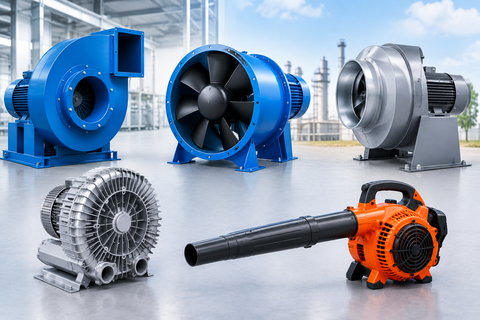
Air blowers are available in several configurations. Each type is designed for specific airflow, pressure, and operating conditions.
1. Centrifugal Air Blower
A centrifugal air blower uses a rotating impeller to draw air into its center and accelerate it outward. The blower housing directs the moving air toward the discharge outlet.
It is widely used in industrial ventilation, dust collection, cooling, and combustion systems.
Key characteristics:
Suitable for continuous airflow applications.
Available in different pressure configurations.
Supports various industrial operating conditions.
Performance depends on impeller design and system resistance.
2. Roots Blower
A Roots blower is a positive displacement machine that uses two synchronized rotating lobes inside a housing. As the lobes rotate, they carry air from the inlet toward the discharge side.
Roots blowers are commonly used in wastewater treatment, pneumatic conveying, and industrial aeration systems.
Key characteristics:
Provides relatively consistent airflow.
Suitable for continuous-duty operations.
Uses synchronized rotating lobes.
Requires appropriate lubrication and operating clearances.
3. Regenerative Blower
A regenerative blower, also known as a side-channel blower, uses a specially designed impeller and side channel to circulate air repeatedly. Multiple energy-transfer interactions increase pressure as air moves through the blower.
It is commonly used in vacuum handling, packaging machinery, and aeration applications.
Key characteristics:
Compact construction.
Suitable for moderate pressure or vacuum requirements.
Often designed for relatively low-maintenance operation.
Performance depends on air temperature and system resistance.
4. Screw Blower
A screw blower uses two intermeshing helical rotors to move air through a compression chamber. As the rotors turn, air travels along the chamber toward the discharge outlet.
Screw blowers are used in wastewater treatment, industrial processing, and applications requiring continuous airflow.
Key characteristics:
Designed for continuous operation.
Provides controlled airflow.
Can operate efficiently under suitable conditions.
Requires accurate rotor alignment and maintenance.
5. Rotary Vane Blower
A rotary vane blower contains a rotating rotor with sliding vanes positioned inside an eccentric housing. As the rotor turns, the vanes create chambers that change in volume and move air through the machine.
These blowers are used in vacuum systems, industrial equipment, and certain material-handling processes.
Key characteristics:
Compact mechanical arrangement.
Suitable for specific pressure and vacuum applications.
Uses sliding vanes to move air.
Requires attention to vane condition and lubrication.
6. High-Speed Turbo Blower
A high-speed turbo blower uses a rapidly rotating impeller to generate airflow. Some designs use air or magnetic bearings to reduce mechanical contact and support high-speed operation.
These blowers are frequently used in wastewater aeration and large industrial processes.
Key characteristics:
High-speed operation.
Designed for substantial airflow requirements.
May use advanced bearing technology.
Requires suitable controls and operating conditions.
Air Blower Types Compared
Blower Type | Working Principle | Common Industrial Uses |
|---|---|---|
Centrifugal | Dynamic impeller action | Ventilation, cooling, dust collection |
Roots | Positive displacement | Aeration, pneumatic conveying |
Regenerative | Side-channel air circulation | Vacuum handling, packaging |
Screw | Helical rotor displacement | Industrial aeration, processing |
Rotary vane | Sliding vane displacement | Vacuum systems, material handling |
Turbo | High-speed dynamic action | Wastewater treatment, industrial aeration |
The appropriate blower depends on airflow demand, operating pressure, duty cycle, energy consumption, and system conditions.
What Are the Main Components of an Air Blower?
Although construction varies between blower types, most air blowers contain several important components.
1. Electric Motor
The motor provides the mechanical power required to operate the blower. Its capacity and operating characteristics influence overall performance.
2. Impeller or Rotor
The impeller or rotor moves air through the machine. Its design depends on whether the blower operates through dynamic action or positive displacement.
3. Blower Housing
The housing contains the internal mechanism and guides air through the inlet and discharge passages.
4. Air Inlet
The inlet allows air to enter the blower. Filters may be installed to reduce dust and other contaminants entering the equipment.
5. Air Outlet
The outlet directs moving air into a connected pipeline, duct, or industrial system.
6. Bearings
Bearings support rotating components and help maintain proper alignment during operation.
7. Cooling System
Some air blowers use cooling arrangements to manage heat generated during operation. Cooling requirements depend on the equipment design and operating conditions.
8. Control System
The control system manages operating conditions such as motor speed, temperature, pressure, and equipment protection.
Where Are Air Blowers Used in Industry?
Air blowers support many industrial operations because controlled airflow is essential for production, processing, and environmental systems.
Wastewater Treatment
Air blowers supply oxygen to aeration tanks, supporting biological processes that help microorganisms break down organic matter. Roots, screw, and turbo blowers are commonly considered for these applications.
Manufacturing Industry
Manufacturing facilities use blowers for cooling, drying, ventilation, dust removal, and material movement. Their role depends on the production process and required airflow conditions.
Food Processing
Air blowers support drying, cooling, product handling, and ventilation in food processing facilities. Equipment used in these environments must meet applicable hygiene and material requirements.
Chemical Industry
Chemical processing facilities use blowers for ventilation, gas movement, combustion support, and certain material-handling operations. Equipment selection must account for the properties of the gases involved.
Cement Industry
Blowers are used in pneumatic conveying, combustion systems, dust collection, and material processing. They help move air through different stages of cement production.
Textile Industry
Textile facilities use air blowers for fabric drying, lint removal, cooling, and ventilation. Controlled airflow can support consistent production conditions.
Power Generation
Air blowers support combustion systems, boiler operations, cooling processes, and ventilation in power plants.
Agriculture
Agricultural applications include grain drying, ventilation in storage facilities, greenhouse air circulation, and certain material-handling processes.
What Are the Benefits of Using Air Blowers?
Air blowers provide several operational benefits when properly matched to the application.
Controlled airflow: Deliver air according to process requirements.
Industrial versatility: Support a wide range of applications through different designs.
Process support: Help maintain aeration, cooling, drying, and conveying operations.
Continuous operation: Many industrial models are designed for extended operating cycles.
System integration: Connect with ducts, pipelines, filters, and automated equipment.
Flexible configurations: Accommodate varying pressure and airflow requirements.
Actual performance and efficiency depend on equipment specifications, installation conditions, and operating practices.
Air Blower vs. Air Compressor: What Is the Difference?
Air blowers and air compressors both move air and increase its pressure, but they serve different operating requirements.
Comparison Factor | Air Blower | Air Compressor |
|---|---|---|
Main function | Moves air at relatively low or moderate pressure | Compresses air to higher pressures |
Pressure range | Generally lower | Generally higher |
Typical applications | Aeration, ventilation, drying | Pneumatic tools, industrial air systems |
Air delivery | Continuous airflow in many designs | Continuous or intermittent, depending on design |
Equipment examples | Centrifugal, Roots, regenerative | Reciprocating, rotary screw, centrifugal |
The distinction is not absolute because operating pressure ranges can overlap. Equipment specifications and connected-system requirements should determine the appropriate choice.
How to Choose the Right Air Blower
Selecting an appropriate air blower requires evaluating operating conditions rather than choosing equipment based only on motor capacity.
Airflow Requirements
Determine the required airflow volume for the application. Airflow is commonly measured in cubic meters per hour (m³/h) or cubic feet per minute (CFM).
Operating Pressure
Identify the pressure needed to overcome pipeline resistance, equipment restrictions, and process requirements.
Blower Type
Choose a blower design that matches the application. Centrifugal blowers may suit dynamic airflow requirements, while positive displacement blowers may be appropriate when relatively consistent air delivery is needed.
Operating Environment
Consider ambient temperature, humidity, dust levels, and exposure to corrosive or hazardous substances.
Energy Efficiency
Evaluate power consumption under actual operating conditions. A blower should be selected according to its performance curve rather than its maximum advertised capacity alone.
Noise and Vibration
Noise and vibration can affect workplace conditions and equipment reliability. Check the manufacturer's operating specifications and installation recommendations.
Maintenance Requirements
Consider lubrication, filter replacement, bearing inspection, and the availability of maintenance components.
Air Blower Maintenance: Best Practices
Regular maintenance helps maintain airflow performance, reduce unexpected downtime, and extend equipment life.
Inspect air filters: Clean or replace filters according to the manufacturer's maintenance schedule.
Check bearings: Monitor bearing temperature, noise, and vibration.
Inspect belts and couplings: Check alignment, tension, and wear where applicable.
Monitor motor performance: Observe electrical conditions and operating temperature.
Check air passages: Remove accumulated dust or obstructions from accessible passages.
Inspect connections: Check ducts, pipelines, and joints for leakage.
Monitor operating pressure: Compare actual pressure and airflow with expected operating conditions.
Follow lubrication instructions: Use the lubricant and maintenance intervals specified by the manufacturer.
Maintenance procedures should follow the equipment manual and applicable workplace safety requirements. Electrical isolation and lockout procedures are important before inspection or repair.
Common Air Blower Problems and Their Causes
Air blowers can experience performance problems due to mechanical wear, incorrect installation, unsuitable operating conditions, or restricted airflow.
Common Problem | Possible Cause | Recommended Action |
|---|---|---|
Reduced airflow | Blocked filter or inlet | Inspect and clean the air intake |
Excessive vibration | Misalignment or damaged components | Inspect alignment and rotating parts |
High operating temperature | Poor ventilation or excessive load | Check cooling and operating conditions |
Unusual noise | Bearing wear or loose components | Inspect bearings and fasteners |
High energy consumption | Incorrect sizing or system resistance | Review operating conditions |
Air leakage | Damaged seals or loose connections | Inspect and repair connections |
A qualified technician should investigate persistent or severe problems before the equipment is returned to operation.
What Are the Limitations of Air Blowers?
Despite their wide range of applications, air blowers have certain limitations.
They may not provide the high pressure required by some compressed-air applications.
Performance can decline when filters or air passages become obstructed.
Certain designs generate significant noise and vibration.
Continuous operation can produce heat that requires appropriate cooling.
Improper sizing can increase energy consumption.
Some applications require specialized materials or protective construction.
Understanding these limitations helps engineers select equipment that matches the operating environment and process requirements.
Future Developments in Air Blower Technology
Air blower technology continues to develop through improvements in motor design, controls, materials, and monitoring systems.
Variable Speed Technology
Variable frequency drives allow motor speed to be adjusted according to changing airflow requirements. This can help reduce unnecessary energy consumption in suitable applications.
Smart Monitoring Systems
Modern monitoring systems can track operating temperature, pressure, vibration, and other performance indicators. These measurements can support condition-based maintenance.
High-Efficiency Motors
Advancements in motor technology help improve energy performance and reduce electrical losses.
Advanced Bearing Systems
Air and magnetic bearing technologies are used in certain high-speed blower designs to reduce mechanical contact and support efficient operation.
Improved Equipment Design
Developments in impeller geometry, rotor design, and airflow management continue to improve blower performance for specific industrial applications.
Frequently Asked Questions About Air Blowers
1. What is the main purpose of an air blower?
The main purpose of an air blower is to move air or gas while generating the pressure required for a particular process. It is commonly used for ventilation, aeration, cooling, drying, and material handling.
2. What are the main types of air blowers?
The main types include centrifugal, Roots, regenerative, screw, rotary vane, and high-speed turbo blowers. Each type operates differently and supports specific airflow and pressure requirements.
3. What is the difference between a fan and an air blower?
A fan generally moves large volumes of air at relatively low pressure. An air blower is typically designed to generate greater pressure, although the exact distinction depends on equipment design and industry classification.
4. Where are air blowers commonly used?
Air blowers are used in wastewater treatment, manufacturing, food processing, chemical plants, cement production, textile facilities, power generation, and agriculture.
5. How is air blower capacity measured?
Airflow capacity is commonly measured in CFM or m³/h. Operating pressure is measured in units such as pascals, kilopascals, or bar.
6. Which air blower is used in wastewater treatment?
Roots, screw, and turbo blowers are commonly used in wastewater treatment aeration systems. The appropriate type depends on airflow demand, tank configuration, operating pressure, and energy requirements.
7. Can an air blower operate continuously?
Many industrial air blowers are designed for continuous-duty operation. However, continuous operation depends on the manufacturer's specifications, cooling arrangements, maintenance schedule, and operating conditions.
8. What causes an air blower to overheat?
Common causes include excessive operating load, restricted airflow, poor ventilation, bearing problems, incorrect lubrication, and unsuitable operating conditions.
9. How often should an air blower be maintained?
Maintenance frequency depends on the blower type, operating hours, environmental conditions, and manufacturer's recommendations. Regular inspections help identify problems before they cause equipment failure.
10. How do you select the right air blower?
Evaluate airflow capacity, operating pressure, blower type, energy requirements, operating environment, noise levels, maintenance needs, and system compatibility.
Conclusion
Air blowers are important components in industrial and commercial systems that require controlled airflow and pressure. Their different operating principles and configurations make them suitable for applications ranging from wastewater aeration and manufacturing to ventilation, drying, and pneumatic conveying. Understanding blower types, working principles, performance requirements, and maintenance practices helps ensure reliable operation and appropriate equipment selection.

Related Post...
Universal Tensile Testing Machine Guide: Types, Working and Uses
Updated: November 16, 2026
Read More
Corrosion Testing Chambers Explained: Salt Spray Types and Uses
Updated: November 16, 2026
Read More