Electrical Connectors: Types, Uses and How They Work
Electrical connectors are essential components that join electrical wires, cables, and circuits to establish reliable connections for power and signal transmission.
They are used in homes, industrial equipment, automotive systems, electronic devices, and communication networks to support safe and efficient electrical operation.
Key Takeaways
Electrical connectors establish connections between wires, cables, and circuits.
Different connector types support specific electrical applications.
Proper selection and installation improve connection reliability and safety.
What Are Electrical Connectors?
Electrical connectors are electromechanical components designed to join two or more electrical conductors. They create a connection that allows electrical current or signals to travel between connected components.
Connectors are available in different shapes, sizes, materials, and configurations. Some are designed for permanent installations, while others allow repeated connection and disconnection.
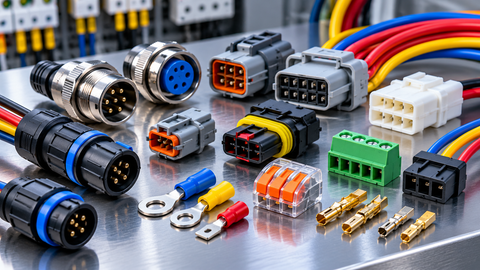
Common examples include plug-and-socket connectors, terminal blocks, wire connectors, circular connectors, and USB connectors.
Electrical connectors are selected according to factors such as voltage, current capacity, conductor size, environmental conditions, and application requirements.
How Do Electrical Connectors Work?
Electrical connectors work by creating a conductive path between two or more electrical components. Their metal contacts establish the electrical connection, while the connector housing helps maintain alignment and protect the contact points.
The basic working process involves the following steps:
Conductor preparation: Wires or cables are prepared according to the connector's installation requirements.
Contact engagement: Conductive terminals connect with the corresponding contacts.
Electrical continuity: The connected metal surfaces create a path for current or signal transmission.
Mechanical retention: Locking mechanisms, screws, clips, or other features hold the connection in position.
Insulation and protection: The connector housing helps prevent accidental contact and protects internal components.
Main Working Principles
Electrical connectors rely on two important principles:
Electrical conductivity: Conductive materials, commonly copper alloys or other suitable metals, allow electrical current to pass between connected components.
Mechanical contact: Contact pressure and connector design maintain physical contact between conductive surfaces, helping provide a stable electrical connection.
A connector's performance depends on contact resistance, material quality, mechanical stability, installation accuracy, and operating conditions.
What Are the Different Types of Electrical Connectors?
Electrical connectors come in many designs to support different electrical systems and operating environments.
1. Wire-to-Wire Connectors
Wire-to-wire connectors join two or more electrical wires. They are commonly used in electrical installations, appliances, automotive wiring, and control panels.
These connectors are available in several configurations, including crimp connectors, twist-on wire connectors, and insulated splice connectors.
Key characteristics:
Join separate electrical conductors.
Available in different wire-size ranges.
Support permanent or detachable connections, depending on design.
Require compatibility with conductor material and size.
2. Wire-to-Board Connectors
Wire-to-board connectors connect individual wires to a printed circuit board (PCB). They are widely used in electronic devices, control systems, and electrical equipment.
They typically consist of a wire-mounted housing and a corresponding PCB-mounted header.
Key characteristics:
Connect external wires to circuit boards.
Available in different pin configurations.
Support compact electronic assemblies.
May include locking mechanisms to maintain connection stability.
3. Board-to-Board Connectors
Board-to-board connectors establish electrical connections between two printed circuit boards without requiring separate wiring.
They are commonly used in computers, communication equipment, consumer electronics, and embedded systems.
Key characteristics:
Connect multiple circuit boards.
Available in different contact arrangements.
Support compact electronic designs.
May provide vertical, horizontal, or stacking connections.
4. Circular Connectors
Circular connectors have a round housing and are designed to connect electrical or electronic circuits. They are frequently used in industrial machinery, automation systems, transportation equipment, and communication devices.
Some circular connectors include threaded, bayonet, or push-pull locking mechanisms.
Key characteristics:
Circular housing design.
Available with multiple contact arrangements.
Some models provide environmental sealing.
Suitable for applications requiring secure connections.
5. Coaxial Connectors
Coaxial connectors are designed to connect coaxial cables used for radio frequency (RF), video, and communication signals.
Common examples include BNC, SMA, TNC, and F-type connectors.
Key characteristics:
Designed for coaxial cable connections.
Support radio frequency signal transmission.
Available in different impedance configurations.
Used in communication and electronic testing equipment.
6. Terminal Block Connectors
Terminal blocks provide connection points for electrical wires inside control panels, distribution systems, and industrial equipment.
They commonly use screw, spring-clamp, or push-in mechanisms to hold conductors securely.
Key characteristics:
Organize multiple electrical connections.
Available in modular configurations.
Support different conductor sizes.
Simplify wiring arrangements in control panels.
7. USB Connectors
USB connectors are widely used for data communication and power connections between electronic devices.
Common versions include USB Type-A, USB Type-B, Micro-USB, and USB Type-C.
Key characteristics:
Support data transmission.
Can provide electrical power.
Available in different connector shapes and specifications.
Commonly used in computers, mobile devices, and peripherals.
8. Power Connectors
Power connectors are designed to carry electrical power between equipment, cables, and power sources.
Examples include AC power plugs, DC barrel connectors, appliance connectors, and industrial power connectors.
Key characteristics:
Designed for specific voltage and current requirements.
Available in different contact arrangements.
May include grounding and protective features.
Used in residential, commercial, and industrial electrical systems.
Electrical Connector Types Comparison
Connector Type | Main Function | Common Applications |
|---|---|---|
Wire-to-wire | Joins electrical wires | Appliances, wiring systems |
Wire-to-board | Connects wires to PCBs | Electronic equipment |
Board-to-board | Connects circuit boards | Computers, embedded systems |
Circular | Connects electrical or signal circuits | Industrial machinery |
Coaxial | Connects RF cables | Antennas, communication equipment |
Terminal block | Organizes wire connections | Control panels |
USB | Transfers data and power | Computers, mobile devices |
Power connector | Transfers electrical power | Electrical equipment |
The appropriate connector depends on electrical specifications, mechanical requirements, environmental exposure, and installation conditions.
What Are the Main Components of an Electrical Connector?
Although connector construction varies, most electrical connectors contain several essential components.
1. Contact Terminals
Contact terminals are conductive elements that establish the electrical connection. They are commonly manufactured from copper alloys and may receive surface plating to improve conductivity and corrosion resistance.
2. Connector Housing
The housing holds the terminals in their correct positions and provides mechanical protection. It is commonly manufactured from insulating materials such as engineering plastics.
3. Insulator
The insulator separates conductive contacts and helps prevent unintended electrical contact between terminals.
4. Locking Mechanism
Locking mechanisms hold connector halves together. Depending on the design, they may use clips, screws, threads, latches, or bayonet arrangements.
5. Seals and Gaskets
Some connectors include seals and gaskets to reduce the entry of moisture, dust, and other contaminants.
6. Cable Entry and Strain Relief
Cable entry components guide wires into the connector. Strain relief helps reduce mechanical stress on the cable and electrical termination.
7. Protective Cover
Certain connectors include protective covers or caps to shield exposed contacts when they are disconnected.
Where Are Electrical Connectors Used?
Electrical connectors are used in almost every industry that depends on electrical power, electronic signals, or communication systems.
Automotive Industry
Vehicles contain numerous electrical connectors that link sensors, control units, lighting systems, batteries, and electronic modules.
Automotive connectors are designed to withstand vibration, temperature changes, moisture, and other operating conditions.
Industrial Automation
Industrial facilities use connectors in programmable logic controllers, sensors, motors, robotic systems, and control panels.
They help establish electrical connections between machines and automation equipment.
Consumer Electronics
Computers, televisions, smartphones, gaming systems, and household electronics use connectors for power delivery, data transmission, and internal circuit connections.
Telecommunications
Communication equipment uses electrical and coaxial connectors to support signal transmission between antennas, cables, networking devices, and electronic systems.
Aerospace Industry
Aircraft and aerospace equipment use specialized connectors designed for demanding environmental and mechanical conditions.
These connectors may require resistance to vibration, temperature variations, moisture, and other operational stresses.
Medical Equipment
Medical devices use electrical connectors to link sensors, monitoring equipment, power systems, and electronic components.
Connectors used in medical environments must meet the relevant electrical safety, material, and regulatory requirements.
Renewable Energy Systems
Solar power installations and other renewable energy systems use connectors to link electrical cables, inverters, panels, and monitoring equipment.
Photovoltaic connectors are specifically designed for suitable solar installations and outdoor exposure.
Household Electrical Systems
Homes use electrical connectors in lighting, appliances, distribution panels, switches, and wiring installations.
Correct connector selection and installation are essential for electrical safety.
What Are the Benefits of Electrical Connectors?
Electrical connectors provide several important advantages in electrical and electronic systems.
Reliable connections: Properly selected connectors establish stable electrical contact.
Easy installation: Many connector designs simplify wiring and equipment assembly.
Maintenance convenience: Detachable connectors allow components to be disconnected when required.
System flexibility: Different configurations support various electrical arrangements.
Space efficiency: Compact connector designs support smaller electronic equipment.
Mechanical protection: Housings and locking mechanisms help protect electrical contacts.
Application versatility: Connectors are available for power, signal, data, and specialized applications.
Actual performance depends on connector quality, installation practices, and compatibility with the electrical system.
Electrical Connectors vs. Electrical Terminals: What Is the Difference?
Electrical connectors and electrical terminals are closely related, but they perform different roles in an electrical connection.
Comparison Factor | Electrical Connector | Electrical Terminal |
|---|---|---|
Main function | Joins two or more electrical components | Provides a termination point for a conductor |
Construction | May contain multiple contacts and a housing | Usually a conductive contact or connection point |
Connection arrangement | Often connects with a matching connector | May connect to a wire, stud, or terminal block |
Common examples | USB, circular, plug-and-socket | Ring, spade, pin, blade |
Typical applications | Electronic devices, machinery, cables | Wiring, control panels, electrical assemblies |
A terminal can be part of a larger connector assembly. The terms should not be treated as interchangeable in every electrical application.
How to Choose the Right Electrical Connector
Selecting an electrical connector requires evaluating electrical, mechanical, and environmental requirements.
Voltage Rating
Check the connector's rated voltage and ensure it is suitable for the electrical system. Operating above the specified rating can create insulation and safety risks.
Current Capacity
Determine the expected current flowing through the connector. Current capacity depends on contact design, conductor size, material, temperature, and installation conditions.
Wire Size Compatibility
The connector must support the conductor's size and type. An incompatible connection can lead to poor contact, overheating, or mechanical failure.
Connector Material
Contact materials and surface plating influence conductivity, corrosion resistance, and durability. Select materials appropriate for the operating environment.
Environmental Protection
Consider exposure to moisture, dust, chemicals, vibration, and temperature changes. In demanding environments, an appropriate ingress protection rating may be necessary.
Connection Type
Choose between permanent and detachable connection arrangements based on installation and maintenance requirements.
Mechanical Requirements
Evaluate locking arrangements, mating cycles, vibration resistance, cable strain relief, and available installation space.
Applicable Standards
Check relevant electrical and industry standards for the application. Requirements may differ across residential, industrial, automotive, and specialized equipment.
Electrical Connector Installation and Maintenance Best Practices
Correct installation and regular inspection help maintain electrical continuity and reduce connection-related failures.
Check compatibility: Confirm the connector matches the wire size, voltage, current, and application.
Inspect contact surfaces: Look for corrosion, contamination, or physical damage.
Prepare conductors correctly: Strip insulation according to the manufacturer's specified dimensions.
Use appropriate tools: Select compatible crimping, termination, and installation tools.
Secure connections: Follow the specified crimping or tightening requirements.
Check locking mechanisms: Ensure detachable connectors are fully engaged.
Inspect insulation: Look for damaged housings, seals, or exposed conductors.
Monitor operating temperature: Investigate abnormal heating during operation.
Check environmental protection: Ensure seals and protective covers remain in suitable condition.
Replace damaged components: Do not continue using connectors with cracked housings, loose contacts, or damaged terminals.
Electrical work should be performed by qualified personnel using appropriate isolation and safety procedures.
Common Electrical Connector Problems and Their Causes
Electrical connectors can develop faults due to mechanical damage, environmental exposure, incorrect installation, or electrical overload.
Common Problem | Possible Cause | Recommended Action |
|---|---|---|
Loose connection | Incorrect installation or damaged locking mechanism | Inspect and secure the connection |
Overheating | Excessive current or high contact resistance | Check electrical ratings and contact condition |
Corrosion | Moisture or chemical exposure | Inspect and replace affected components |
Intermittent connection | Worn or misaligned contacts | Check connector alignment and contact condition |
Broken housing | Mechanical stress or impact | Replace damaged connector |
Signal interference | Poor shielding or unsuitable connector | Check compatibility and cable termination |
Insulation damage | Heat, abrasion, or aging | Replace damaged components |
Persistent electrical faults should be investigated before equipment is returned to operation.
What Are the Common Electrical Connector Standards?
Electrical connector standards help establish requirements for safety, performance, dimensions, and compatibility.
Some commonly referenced standards and organizations include:
IEC: The International Electrotechnical Commission develops international standards covering electrical and electronic technologies.
UL: Underwriters Laboratories develops safety standards and certification programs for various electrical products.
ISO: The International Organization for Standardization publishes standards used across multiple industries.
DIN: German standards developed by the German Institute for Standardization cover many electrical and engineering applications.
SAE: SAE International develops standards for automotive and aerospace technologies.
IPC: IPC publishes standards related to electronic assemblies, printed circuit boards, and interconnection processes.
The applicable standard depends on connector type, intended application, operating environment, and destination market.
Future Developments in Electrical Connector Technology
Electrical connector technology continues to evolve as electrical systems become more compact, automated, and data-intensive.
Miniaturized Connector Designs
Modern electronic devices require smaller components without sacrificing electrical performance. Manufacturers continue developing compact connectors for portable devices and embedded systems.
High-Speed Data Connectivity
Communication networks and computing equipment require connectors that support higher data transmission rates and signal integrity.
Electric Vehicle Connectors
Electric vehicle development is increasing the importance of specialized connectors for battery systems, charging equipment, and high-voltage electrical architectures.
Advanced Materials
New contact materials, plating technologies, and insulating polymers help improve electrical performance, durability, and environmental resistance.
Smart Connection Monitoring
Some advanced electrical systems use monitoring technologies to identify abnormal temperature, connection conditions, and potential faults.
Improved Environmental Protection
Connector designs increasingly address exposure to moisture, dust, vibration, and temperature changes in demanding applications.
Frequently Asked Questions About Electrical Connectors
1. What is the main purpose of an electrical connector?
An electrical connector joins wires, cables, or electronic components to establish a conductive path for power or signal transmission.
2. What are the most common types of electrical connectors?
Common types include wire-to-wire, wire-to-board, board-to-board, circular, coaxial, terminal block, USB, and power connectors.
3. What materials are used to manufacture electrical connectors?
Conductive contacts are commonly manufactured from copper alloys, brass, or other suitable conductive materials. Connector housings often use insulating plastics or other engineering materials.
4. What is the difference between male and female connectors?
A male connector generally contains projecting contacts or pins, while a female connector contains corresponding sockets or receptacles. The exact design depends on the connector family.
5. How do you identify an electrical connector?
A connector can be identified by its shape, contact arrangement, dimensions, markings, manufacturer information, voltage rating, and intended application.
6. Why do electrical connectors overheat?
Overheating can result from excessive current, loose connections, corrosion, damaged contacts, incorrect wire sizing, or poor installation.
7. Are electrical connectors waterproof?
Some electrical connectors are designed with environmental seals and specified ingress protection ratings. However, not all connectors are waterproof, and their suitability depends on the manufacturer's specifications.
8. What is a crimp connector?
A crimp connector is an electrical terminal or connector attached to a conductor by mechanically compressing it around the wire using an appropriate crimping tool.
9. Where are circular electrical connectors used?
Circular connectors are used in industrial machinery, automation equipment, transportation systems, communication devices, and other applications requiring secure electrical connections.
10. How do you select the correct electrical connector?
Consider voltage, current, wire size, contact arrangement, environmental protection, mechanical requirements, installation method, and applicable industry standards.
Conclusion
Electrical connectors are fundamental components that support power distribution and signal transmission across residential, commercial, and industrial systems. Different connector types serve specific purposes, from joining wires and circuit boards to connecting communication equipment and high-power electrical systems. Understanding their construction, working principles, applications, and selection requirements helps maintain reliable electrical connections and improve overall system safety.

Related Post...
Corrosion Testing Chambers Explained: Salt Spray Types and Uses
Updated: November 21, 2026
Read More